You can see many situations where it is important to analyze things at this level. Without it science would be entirely useless to us. But there are many negative sides to unrestrained critical thinking that we fail to address. Critical thinking is a means to an end. The ability to deconstruct an argument does not grant us enlightenment. It merely helps to clear obstacles that may stand in our way. It is a wrecking ball. It does not build anything, it only tears it down. You may need to tear down an old rickety building on occasion to make room for a newer and stronger structure. You may need to prune a tree from time to time in order for it to bear good fruit. But if we continue to knock down building after building and cut down branch after branch, we will be left with nothing left. (The following comic from XKCD is a great example of this)
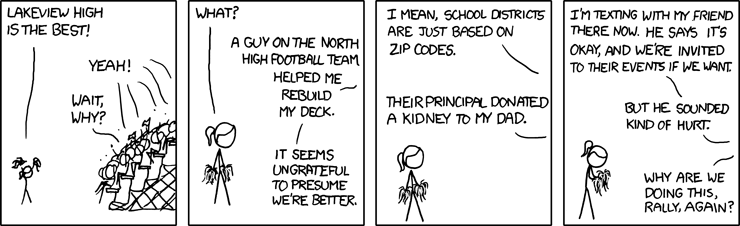
Going through a questioning process in which we challenge our old beliefs and prejudices is a normal and healthy part of spiritual growth. But we need to be careful about our approach. Done one way, it will lead us to greater compassion and understanding for others. Done another way it will lead to cynicism and skepticism of everything and everyone in the world around us. I just listened to a devotional address given by David Bednar several years ago where he talked about this from a very different angle. Substitute the word ‘discernment’ used here with ‘critical thinking’.
"As we integrate the teachings of Presidents Cannon and Richards, we learn that the gift of discernment operates basically in four major ways.Too often, we operate in the first way; we look for hidden error and evil in others. If we do not balance it with the other three approaches, our view of reality will become horribly distorted. As Jesus taught, “First cast out the beam from thine own eye, and then shalt thou see clearly to cast out the mote from thy brother’s eye”. As I am coming to a point of resolution in my faith crisis, I can say that no truer words have been spoken. If we look for hidden evil in others, we will find it. The church is not a perfect institution. It is made up of human beings. But I found no peace or solace until I turned my attention away from seeking out the flaws in others and instead started looking inward at my own flaws. When I talk about flaws, I do not necessarily mean sin. In my case, one of these flaws was an inability to deal with uncertainty and ambiguity. I felt a need for control. I was unable to tolerate imperfection in myself. These types of false “core beliefs” as psychologists call them can heavily influence our world view. The things I observed about the church and religion and my emotional reaction to them were in large part a reflection of insecurities in myself. Once I began to realize that, a lot of the problems became non-issues. Finding peace in a faith crisis is not about finding answers to questions, or ignoring them. It instead comes by transcending them and living on a higher plain of consciousness.
First, as we “read under the surface,” discernment helps us detect hidden error and evil in others.
Second, and more important, it helps us detect hidden errors and evil in ourselves. Thus the spiritual gift of discernment is not exclusively about discerning other people and situations, but, as President Cannon taught, it is also about discerning things as they really are within us. Third, it helps us find and bring forth the good that may be concealed in others.
And fourth, it helps us find and bring forth the good that may be concealed in us. Oh, what a blessing and a source of protection and direction is the spiritual gift of discernment!"
This is a really abstract idea to grapple with. It can seem paradoxical and contradictory. Psychologist James Fowler’s book “Stages of Faith” puts this transition into a nice framework. He lists six stages through which a person might go through in their personal faith journey. Stages 1 and 2 are related to early childhood development and not really relevant to our discussion, and stage 6 is an exceptional category Fowler uses to describe people like Gandhi and Mother Theresa. We’ll focus on stages 3, 4, and 5. I’m not going to try and accurately distill the entire contents of a book in a few sentences, so here are the over-simplified stages as they apply to Mormonism:
In Stage 3, we have a testimony. We know the church is true. EFY is awesome. The prophet and apostles are always right. We have the truth, arise and shine forth! We look to authority for truth. This authority can come in the form of scriptures or church leaders. Truth is a matter of black and white. Everything can be put into the camps of right and wrong, good and evil. There is no middle ground. I do not mean to paint this is a blind obedience type of faith. There can be a lot of thoughtful worship that goes on at this level. What distinguishes it from the next few levels is that this faith has not been directly challenged and deconstructed.
In Stage 4, we get out the screwdriver and take apart the flashlight, (referring back to my earlier post on the parable of the toy lantern.) We challenge authority and the indoctrination we received. Often, but not always this phase is accompanied by a personal crisis. The black and white thinking becomes replaced by an acknowledgment that the world is a complex and messy place. We see things in color; not everything is good or evil, some things just are.
Stage 5 is weird. The last few weeks I have noticed that I have started to shift into a new way of thinking, but was having serious trouble grasping at words to describe it. My first attempt was to say that it was like looking at a tree. In stage 3, it is just a tree. Trees are simple, we see them every day. They are nice too look at. We know that some have leaves, some of needles, they make energy from sunlight and that they get water from the ground, but that’s as deep as we look. In stage 4, we take a biology class and learn about photosynthesis, and all the chemical processes involved in turning sunlight into energy. We learn about DNA and how cells reproduce. And suddenly this simple tree turns out to be an unbelievably complex and incomprehensible thing. The phase that I’m currently moving into seems like a mass of contradictions. I can look at a tree and see it both for its simplicity and its complexity at the same time. I went back and read the chapter in Fowler’s book on stage five to see if it related to what I was experiencing and if he had a better way of explaining it than me. He seems to be at a lack of words as well, as it is the shortest chapter in the book, but he gets closer than me.
He says:
The emergence of Stage 5 is something like:
o Realizing that the behavior of light requires that it be understood both as a wave phenomenon and as particles of energy.
o Discovering that the rational solution or “explanation” of a problem that seemed so elegant is but a painted canvas covering an intricate, endlessly intriguing cavern of surprising depth.
o Looking at a field of flowers simultaneously through a microscope and a wide-angle lens.
o Discovering that a guest, if invited to do so, will generously reveal the treasured wisdom of a lifetime of experience.
o Discovering that someone who shares your identity also writes checks, makes deposits and stops payments on your checking account.
o Discovering that one’s parents are remarkable people not just because they are one’s parents.
Later in the chapter, Fowler goes on to say,
Like I said at the beginning, this will be my last entry for a while. At least until I feel I have any credential to speak on this new approach to faith in which I am a complete novice. But to anyone else struggling, stay the course. It gets better!
“Stage 5 accepts as axiomatic that truth is more multidimensional and organically interdependent than most theories or accounts of truth can grasp. Religiously, it knows that the symbols, stories, doctrines, and liturgies offered by its own or other traditions are inevitably partial, limited to a particular people’s experience of God and incomplete. Stage 5 also sees, however, that the relativity of religious traditions that matters is not their relativity to each other, but their relativity – their relatetivity – to the reality to which they mediate relation. Conjunctive faith, therefore, is ready for significant encounters with other traditions than its own, expecting that truth has disclosed and will disclose itself in those traditions in ways that may complement or correct its own. ….. This position implies no lack of commitment to one’s own truth tradition. Nor does it mean a wishy-washy neutrality or mere fascination with the exotic features of alien cultures. Rather, Conjunctive faith’s radical openness to the truth of the other stems precisely from its confidence in the reality mediated by its own tradition and in the awareness that that reality overspills its mediation. The person of Stage 5 makes her or his own experience of truth the principle by which other claims to truth are tested. But he or she assumes that each genuine perspective will augment and correct aspects of the other, in a mutual movement toward the real and the true.”Incredibly nebulous, I know, but it resonates quite well with the direction I am currently headed. To anyone else who is struggling, I'm going to level with you and say that there is nothing you can read or think that will suddenly promote you to a level 5 perspective. You have to live through the experience. But please, please, do not get stuck at stage 4. Learn what you need to learn from it, and move on. Do not become entrenched in the cynicism and intellectual elitism that is so easy to fall into during the questioning period. I know for me, when I first heard about Fowler’s stages of faith, Stage 5 seemed like some magical fairytale kingdom filled with Unicorns. It seemed so contrary to reason that anyone could go back to belief. But it is possible, and it happens in a very organic and genuine way that does not require you to abandon your intellectual integrity. Going back to Fowler’s book again,
“Ricoueur’s term ‘second naiveté’ or ‘willed naiveté’ begins to describe Conjunctive faith’s post-critical desire to resubmit to the initiative of the symbolic. It decides to do this, but it has to relearn how to do this. It carries forward the critical capacities and methods of the previous stage, but it no longer trusts them except as tools to avoid self-deception and to order truths encountered in other ways”I think this progression to stage 5 may have been what Jesus meant when he taught that we must be born again, or that we must become as little children. We return to this state of humility and naiveté, but this time it is a willful act of submission. It is more meaningful because it is not a default position we fall into by ignorance. It is instead a conscientious surrender of our intellectual pride. By crushing the ego we eliminate the greatest obstacle to our spiritual progression.
Like I said at the beginning, this will be my last entry for a while. At least until I feel I have any credential to speak on this new approach to faith in which I am a complete novice. But to anyone else struggling, stay the course. It gets better!

I really enjoyed a couple things you said. It helps a lot. Thank you.
ReplyDelete